Showing posts with label journal. Show all posts

Friday, December 11, 2015

True/False - Lesedi Cultural Village


True or False
Lesedi Cultural Village

1. Lesedi is a cultural village for only 1 culture.  TRUE or FALSE?

False!  Lesedi Cultural Village has many different cultures including Xhosa, Zulu, Besotho, Pedi, and Ndebele.  There are mini villages for living in inside of Lesedi, each for a different tribe.


2. You can come visit Lesedi in the day or evening, but you can’t stay overnight.  TRUE or FALSE?

False!  You can stay in Lesedi overnight and also come for the day or evening.  You get to stay in 1 of the guest parts of the living villages.  My family stayed in the Zulu village in a guest part called Nguni.


3. The people in Lesedi welcome their guests by singing a song.  TRUE or FALSE?

True!  The people of Lesedi sing a welcome song in one of their languages when their guests arrive.  They clap, stomp, and dance along to the music.  It is a very joyful welcome!


4. You are not allowed to go through the living villages unless you are going to a guest part.  TRUE or FALSE?

False!  In Lesedi, you get to go through a tour of the villages!  The guide will show you the meeting place of the tribe’s village, the huts for living in, the most respected hut, the food, and the people.  You will also learn lots of facts.  We learned that in most clutures, you have to pay 11 cows to marry 1 wife.  The Besotho people pay 13 cows and 2 horses and Zulu people pay 13 cows.  The Zulu people kill 1 cow out of the 13 to make the wedding outfit. 
We also learned the Besotho boys go into a hut for 3 weeks and up in the mountains for 3 weeks.  We also got to go into a Xhosa hut and hear a clicking song.  The girls go in first and sit to the way that the door opens so they will be protected by the door if an enemy comes.  The boys go out first to make sure it is safe.  Molo!  That’s “hello” in Xhosa.  You can also learn words in the languages.  The tour is very informative.


5. The people in Lesedi put on a show for their guests.  TRUE or FALSE?

True!  The people in Lesedi danced and sang in their traditional outfits as a show for their guests.  Each tribe did their own dance – the Besotho people in their mountain hats and blankets to keep them warm and their rainboats for the mine dance to show that they were the first in the mines; the Zulu in their leopard skin and bead skirts; the Xhosa with their faces painted; and the Pedi with their animals in the bush at night dance.  There was also a loud drum, a xylophone to play, and a stick fighting act.  It was a cool show!

6. I had lots of fun at Lesedi.  TRUE or FALSE?

True!  I loved going to Lesedi!  It was such a cool and interesting experience.  I learned a lot, and I hope to go back!

Sunday, November 1, 2015

South Africa History and Me

The video below is a reading of a book called Nelson Mandela, written and illustrated by Kadir Nelson. Play it to learn about South African history. Read this post to hear about my experiences with South African history.
 

From reading books to seeing the Gugulethu and Soweto townships to seeing Nelson Mandela's house to visiting his prison, I have learned a lot about South African history in my time here.  I'm going to tell you about some of my experiences with learning about South African history.

Robben Island: I took a tour of Robben Island, which is the island where Nelson Mandela was in prison.  In line to get on a ferry to Robben Island I read my little brohter, Ben, the Nelson Mandela book (which is in the video above) to teach him about the history of this country.  On the big ferry to the island, many people joyfully sang a song.

When we got to Robben Island, we took a tour.  Our guide showed us the quarry where the prisoners had to work.  They had to break up the stone to get the limestone out, and sometimes the reflection of the sand and limestone hurt their eyes.  It was hard and dangerous work. 

She also showed us Robert Sobukwe's prison cell.  He was also a leader of fighting apartheid, which is what segregation in South Africa was called.  Once Robert Sobukwe's prison term was over, people were worried about sending him back into South Africa because they thought he could be dangerous.  So they kept him on Robben Island.  His prison cell was big, more like a house, and there was room for his family and children to visit him.  He was no longer a prisoner, but he was not allowed to talk to anyone else on the island.  Not being able to talk sounded awful to me because I usually enjoy talking.

Our guide taught us many facts about Robben Island. Do you know why Robben Island is  called Robben Island? It's because in Dutch, robben means seals, and there were many seals at Robben Island.  Everybody thinks of Robben Island as a sad place because it was where Nelson Mandela and other leaders in fighting apartheid were in prison, but now that Robben Island is not a prison, people have made a little town on it and are trying to make it more of a happy place.

Later, our guide handed us off to a different guide who was a former prisoner on Robben Island.  He showed us a prison cell for many people.  It was long with only little cubbies, 2 long benches, and lots of bunk beds.  He taught us more about life in prison.  Then, he showed us Nelson Mandela's cell.  It was very tiny.  

Nelson's cell was the only one that had a little bucket in it.  This is because in prison, prisoners had only small buckets for toilets.  The bucket is still in the cell to remind us that in some parts of the country, people still have only buckets for toilets.  One lady didn't think that was a good idea, and she argued on and on about why they should take out the bucket.  Everybody snapped lots of photos of Nelson Mandela's prison cell. 

 Gugulethu and Soweto Townships: During apartheid, the black people were forced to move out of their houses and into little neighborhoods called townships.  Some townships had only shacks for houses, and the people in the townships were no longer South African citizens.  Although there is not apartheid anymore, there are still townships.

There are both larger homes and smaller shacks in townships today.

People are not forced to live in them, but some choose to or do not have enough money to live anywhere else.  We have visited 2 townships in our time here.  One is called Gugulethu.  My parents' friend Themba lives in Gugulethu, and we went to his house.  We did drumming and watched Themba play the mbira, an instrument wehre you push down little metal pieces to make music.  If you put it in a gourd bowl, it sounds louder.  We liked how the mbira sounded.
We made a new friend in Gugulethu.  His name is Lihle, and he is Themba's nephew.  Lihle drummed with us and played ball with us, too. He had a creative idea of putting newspapers in a bread sack to make his ball.  The ball worked very well.  We also got to drive through Gugulethu.  It was interesting to see it after being in the big city of Cape Town that it is right outside of.  In Cape Town, there are big grocery stores, big restaurants, big shops, and big houses.  In Gugulethu, there are small grocery stores, small restaurants, small shops, and small houses.  It was a very interesting experience to go to Gugulethu, and I liked going.

We also visited Soweto, a township near Johannesburg.  Soweto stands for South Western Townships.  We took a tour.  On our way to Soweto, we saw Nelson Mandela's house.  (It was his house after he was freed from prison.)  It was huge and so nice!  Nelson Mandela really deserved a great house like that.  Now, Nelson Mandela's grandchildren live in the big house.

By reading a book called Goal, we learned that many children in townships don't have soccer balls, so we took soccer balls to give to children in Soweto.  On our tour, we visited a part of Soweto called Kliptown.  There we saw the Sky Children Center, where we met a man who loves to help children, and he told us about his job.  We also watched some of the children at the center perform a dance.  They danced, clapped, and stomped in their rain boots. Then, we donated soccer balls to the Sky Children Center. The children were thrilled! 

Going to Soweto was also a very interesting experience.  I enjoyed donating the balls because it makes me happy to make other people happy.  Tours are good because you can learn lots of information from your guide about the place you're touring and not just see the place without learning about it.  I liked going on our tour of Soweto.  I am glad that we went to the townships.

South Africa has a lot of interesting history, and primary sources, just like Robben Island and the Gugulethu and Soweto townships, are a great way to learn about it.

Sunday, October 18, 2015

Sadie's Journal: A letter from Kruger National Park


Dear Friends,

I went to Kruger! We went on lots of safaris! We had to wake up at 5:00am for our 1st safari, which we thought was just a morning safari. Actually, it was an all day! Our guide was Burnhard. We saw the big 5 on the 1st day just like Mrs. Marlinda, our neighbor, hoped! (The big 5 is a list of the 5 most dangerous animals to hunt on foot.)

Lion: Burnhard got a report of lions! There they were, a big and lazy male with a silky mane, 2 sleek lionesses, and even 5 little cubs that were so cute! One lioness took the cubs to the watering hole to drink. On one other safari, a lioness crossed the street right behind the vehicle about 2 feet away from me! I think lion cubs are the cutest babies! 


Elephant: Elephants are my favorite animals! We found 3 elephants that I named Duma, Muqua, and Taba after the elephants at Addo Elephant Back Safari (see below). Taba sprayed water all over his head to cool off. We also saw a cute newborn elephant (we called her Muddy) learning to walk!


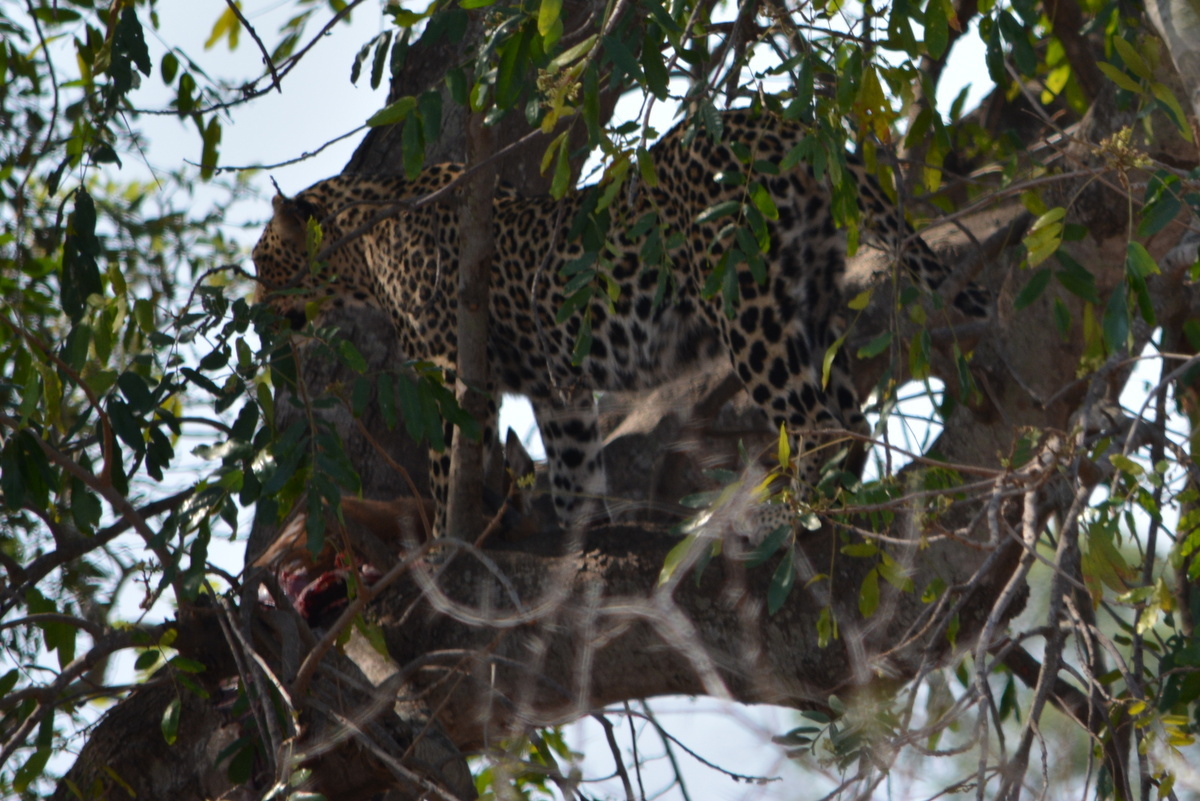
Leopard: We hadn’t seen this in the big 5 before! Unfortunately, this leopard was more of a leopard lump because it was curled up asleep in a shadowy pipe. “3rd pipe,” everybody told us. Ben, my brother, thinks it was a cheetah, but I don’t. It was pretty hard to tell, though! Luckily, we saw a better leopard the next day. It was in a tree eating an impala for lunch! One time, Burnhard joked, “Look! There’s a leopard! Tortoise,” (a leopard tortoise is a kind of tortoise.) 


Cape buffalo: They’re the most
dangerous in the big 5! There, in the rocks by the brook, were 3 Cape buffalo. “Moo,” mooed Burnhard, even though he had said earlier, “No silly noises!” One other day, we saw 2 more Cape buffalo. They were trying to get to a watering hole, but there were lions in the way! We named them Sue and Bill Buffalostien, and I made a comic about them! Here it is:


Black rhinoceros: This was a new one in the big 5, too! It was only Burnhard’s 46th Black rhino! We were on the way to see a leopard, but then we spotted a Black rhino! Burnhard had expected to see a White rhino where it was (which we did on a different safari later), but no! This was a Black rhino. It rolled in the mud while a baboon tried to get some water. We missed the leopard, but it’s more exciting to see a Black rhino because they’re so rare. The Kruger booklet had to have pictures of White rhinos because they couldn’t find any of Black rhinos, and the animal book even said, “Black rhinoceros: seldom seen in Kruger.” We didn’t expect to see a Black rhino!

 
 When we got back to our rental house, 4 zebras were waiting for us! We named them Thike, Nod-Nod, Tri, and Stompy. There were also kudu. One was Keegan, and another was Granny. Some men let us feed Granny. At first she was afraid of us and would only eat out of the bucket, but she finally got used to me and ate out of my hand! I patted her soft nose. I’ve always wanted to pat a wild animal!

I think you’d love seeing all the wild animals in Kruger. There’s so much to see and you never know what you might see!

Love, Sadie


Friday, October 2, 2015

Sadie's Journal: A Letter from Cape Town


Dear Friends,
I just visited Cape Town!  Cape Town is a big city, but unlike most other big cities you don't have to rush, rush, rush.  There are a bunch of fun things to do.  The Atlantic Ocean and Indian Ocean meet not far from Cape Town. 
In Cape Town, there is an aquarium called 2 Oceans Aquarium with fish from both oceans.  You might see a lion fish from the Indian Ocean or a starfish from the Atlantic Ocean.  You might even see sharks and turtles and sea horses or touch anemone!

You might also visit Company Gardens and feed squirrels from your hand!  Now, that’s something you can’t do in America! 
Maybe you would even go up Table Mountain and hike and see cute rock dassies. 
I’m sure you’d go down and visit Boulders Beach.  You would see lots of penguins.  You might even spot cute penguin chicks or watch a penguin lay a egg. 
You’d probably go down to the Cape of Good Hope, too.  Watch out, though!  You might see baboons!  You’ll laugh and laugh if one climbs on somebody’s car, but be careful! 
It might be on your car next!  You might watch sea lions as you take a ship to Robben Island where Nelson Mandela was in prison for a long time.  South Africa once had problems similar to America.  Black people didn’t have as many rights as white people and were treated unfairly. 
Nelson Mandela was sort of like Martin Luther Ling because he tried to stop that.  The white people didn’t like that, so he went to prison.  (Fortunately, he got out and things have changed!)  You might even see Nelson Mandela’s prison cell. 
 
You might also go to a National Park, like West Coast.  You might see fields of gorgeous bright flowers or some zebras, wildebeests, tortoises, and antelope. 
Another thing you might do it go to the crafts market.  You might buy some fun crafts or even make your own mosaic!  You could choose your shape and glue on pretty tiles.  Then, you would group and polish, and voila! you have a beautiful mosaic!  You might go to Cape Town one day, and you might do all of these exciting things – just like me!!  You really might have a great time.
Love,
Sadie Kiel :)

Tuesday, September 29, 2015

Sadie's Journal: Addo Elephant Back Safari


August 26, 2015
Addo Elephant Back Safari!


Sadie: You’ll never believe it, but today I went on an elephant back safari!

Reporter Johnson: What in the world is an elephant back safari?


Sadie: An elephant back safari is a safari, but instead of a big safari vehicle, you ride an elephant!

Reporter Johnson: Wow! Are the elephants trained? Do they have names?

Sadie: Of course the elephants are trained! They do have names. Two of the elephants were called Muqua and Duma. I rode one named Taba. Taba means “happy” in Zulu.

Reporter Johnson: Did you ride alone?


Sadie: No. I wouldn’t know what to do if I were alone! On each elephant there was a guide, and mine was named Donald. We rode in pairs, and I rode with my mom. My dad and Ben rode on Muqua.

Reporter Johnson: Oh. What did it feel like? Smooth? Bumpy? Fun?

Sadie: Fun but bumpy. Taba bump-bumped along as he walked. We bump-bumped along with him! It also hurt a bit. Taba’s hard spine dug into us. Ouch! It was almost like doing the splits for me because Taba was so wide!

Reporter Johnson: Interesting! Did you see any animals while riding Taba?

Sadie: Not many, but some! We found vervet monkeys, a giraffe, impala antelope, and, of course the other elephants!

Reporter Johnson: My! Did you see animals on the way to your elephants?

Sadie: Yes! In addition to what we saw on elephant back, we spotted chickens, blesbok antelope, a different elephant, and BABOONS!

Reporter Johnson: How absolutely fascinating! Did you pat the elephants? What did they feel like?

Sadie: We did pat the elephants! Taba’s skin was wrinkly and hard. Sometimes his flapping ear tickled my leg as we rode! I thought his trunk would be soft and floppy, but actually it was hard and prickly.

Reporter Johnson: Nice! Did you do any other activities with Taba, Muqua, and Duma?


Sadie: Yes! We fed them! I fed Taba. We put the pellets of food in his trunk, and he dumped them in his mouth. He would only eat when I gave hem food, not my mom! There was also another way to feed Taba called the trunk-up way. I did not like that way much. Taba has to hold his trunk up, and we have to dump the food in his mouth. “Now just throw in the food,” my mom told me. I literally threw it in! The only good part about the trunk-up way was that I could see Taba’s huge back molars and his slimy tongue. Feeding was fun!


Reporter Johnson: What was your favorite part of the Addo Elephant Back Safari?

Sadie: Feeding. I really liked how Taba just dumped the food into his mouth. His tongue was really cool. I felt his prickly trunk. We gave Taba elephant chocolate made of fruit and molasses.

Reporter Johnson: Cool! How would you rate your experience with Addo Elephant Back Safari out of 5?

Sadie: 5 and a half!

Reporter Johnson: Would you recommend it to friends?

Sadie: I would highly recommend it! Calling all elephant lovers!! J

Reporter Johnson: Folks, that was Sadie M. Kiel of Memphis, Tennessee, interviewed for Addo Elephant Back Safari! Thank you!